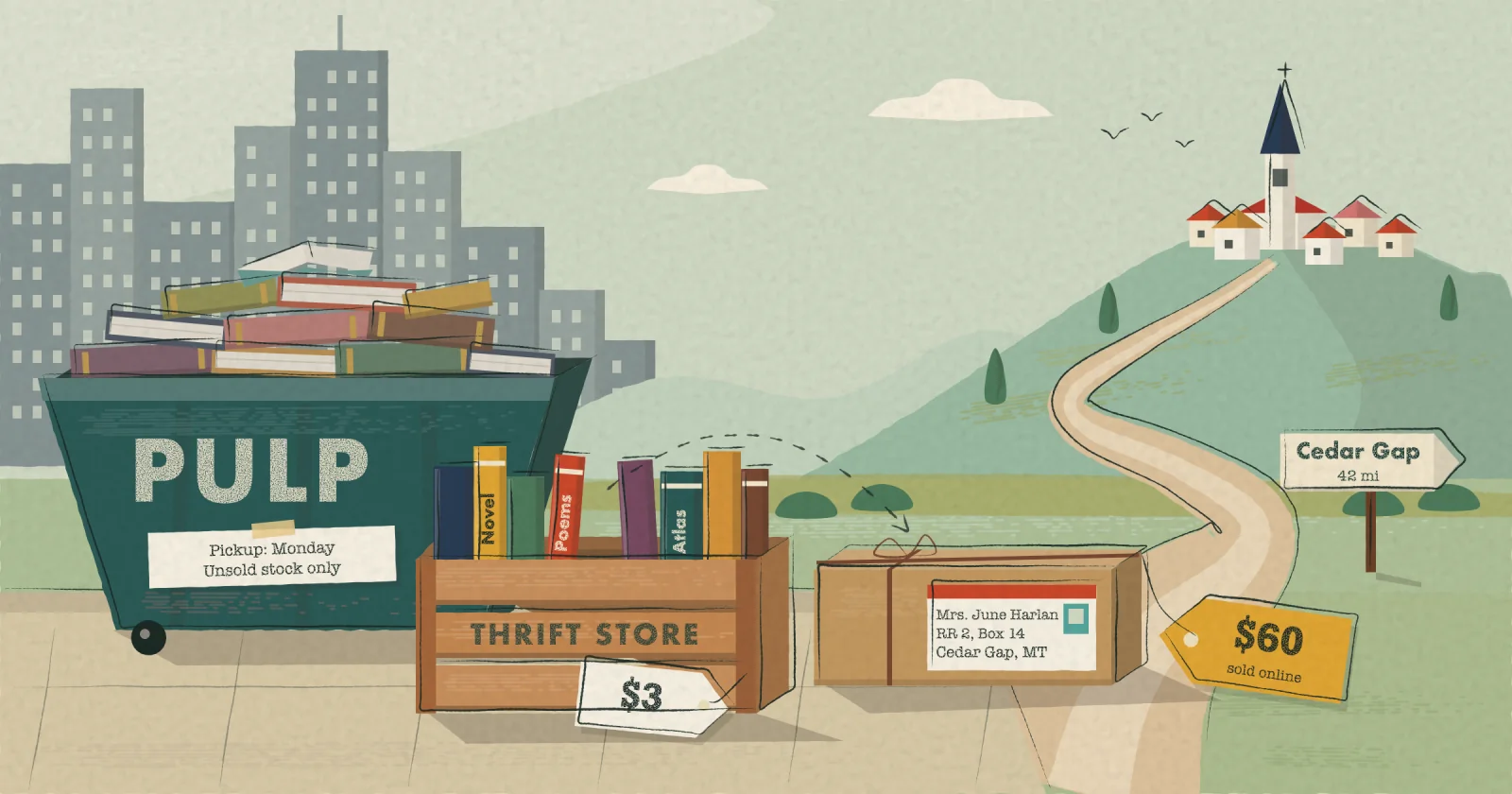
When I tell people I flip used books — buying a book for $3 at Goodwill and selling it for $60 online — two criticisms come up every single time. Always the same two.
1. "You're making culture less accessible by inflating prices."
2. "You're ripping off used bookstores by buying low and selling high."
For a long time, I just shrugged. Eventually I got tired of hearing them and decided to answer them properly. Not to clear my conscience — I'm completely fine with what I do — but because most of these objections rest on a wrong intuition about how the used book market actually works. Once you look at the real mechanics, the picture is roughly the opposite of the predator image people pin on me.
"You're making culture less accessible by inflating prices"
I get why it looks that way. From the outside, buying a book for $3 and selling it for $60 looks like pure predation. But dig in and the argument falls apart on four points.
1. Geographic access
That $3 book on a thrift-store shelf in Chicago was never available to someone living in rural Montana, two hours from the nearest used bookstore. For that reader, the online market is the only option. When I list the book on eBay or Amazon, I'm not taking it away from someone in Chicago. I'm putting it in front of a reader who would never have set foot in that store. That's not restricting access. That's widening it.
2. Prices go down, not up
When I list a book, I always price it slightly below the market median so it sells fast. Other sellers see the sale and adjust. And as soon as a book becomes worth flipping, more resellers jump in. Supply goes up, prices come down. It's pure mechanics.
The price curve of a rare book trends clearly downward once three or four active sellers are working the same edition. A book nobody flips, on the other hand, stays hard to find, or sits at full price with two or three specialist dealers. Flippers add liquidity to a market that would otherwise stall.
3. The one nobody talks about: pulping
Books that sit too long on charity shelves don't wait there forever. They get pulped. The paper is recycled and the content is gone.
Few countries measure this, but France does: according to a survey by the French publishers' association, 13.2% of books distributed in France are destroyed every year — about 26,300 tonnes (2018-2020 averages). That's new books. Unsold used books meet the same fate, just more quietly. When I find a buyer for a niche book nobody has touched in six months, I'm literally saving that copy from the shredder. That's anything but neutral.
4. Who gets the most value out of the book?
More often than not, that $3 thrift-store book ends up with someone who reads it once and donates it back, or never reads it at all. When I put it in front of a collector, a researcher, or an enthusiast who's been hunting for it for three years, the same book "produces" far more value — cultural, intellectual, sometimes professional. Getting a scarce resource to the person who values it most isn't collective impoverishment. It's the opposite.
A corollary that comes up a lot and deserves to be said out loud: a book bought for $100 is a book that gets taken care of. A $3 book gets dog-eared, lent out, lost. The higher the price, the longer the object actually lasts. (If you're wondering why some titles reach those prices in the first place, I broke down the mechanics in why some used books gain value.)
The detail people forget
Every copy I put back into circulation is also, potentially, a new book that doesn't get ordered instead. Extending the life of a book that's already been printed means one less print run. When an industry already destroys more than one book in eight it ships — as it does in France — the last thing it needs is more printing.
"You're ripping off used bookstores by buying low and selling high"
I took this one seriously too. So I asked the people it's supposedly about: used booksellers, thrift-store staff, flea market regulars, the volunteers who run Friends of the Library sales. What most of them told me genuinely surprised me.
They don't care. Some of them are even glad.
The reason is simple: they're drowning in stock. People drop off boxes every week, and stores sometimes have to turn donations away for lack of space. Managing what comes in is their number-one problem, well ahead of moving stock out. A customer who grabs 30 books at once and pays cash is logistical relief, not a loss.
Then there's pricing. Keeping a fair price on 5,000, 10,000 or 50,000 titles whose market value shifts every month is impossible for a shop without a data team. Most price at a reasonable flat rate and would rather turn their stock fast than have it sit for 18 months. That's a deliberate trade-off, not a weakness someone is exploiting.
What I do is actual work
The deepest objection is the idea that I'm "just moving an object from point A to point B." That's wrong.
Sorting 500 books to find the 5 that genuinely have market value takes:
- knowing first editions and recognizing sought-after authors;
- spotting the niches (poker, contemporary dance, marquetry, koi keeping…);
- telling the difference between old and rare;
- grading condition accurately and landing on a credible median price.
That's expert work. Without that sorting, the rare book stays buried under 500 others in a bin, and the buyer — who may have been looking for it for years — never finds it. That's exactly the economic role of a specialist middleman. And this is where the argument flips.
Nobody criticizes used booksellers for existing
A professional used bookseller does exactly what I do: buys lots, sorts, appraises, displays, and resells at a margin. If flipping is immoral, then so is the entire used book trade — from the cramped shop downtown to the giant online warehouses, including every independent bookstore with a rare books shelf. Nobody seriously argues that.
The only difference between a pro bookseller and me is scale and channel. They have a storefront; I have eBay and Amazon. They buy lots from private sellers, and so do I. Nothing ethically meaningful there.
The risk argument everyone overlooks
A bookseller who sells me a lot is guaranteed to have moved that stock. I buy with no guarantee at all. Some of those books will never sell, will gather dust for six months, or will go for less than I estimated. I absorb that risk instead of the bookseller, and instead of the charity system that would have pulped part of the stock.
That's exactly what any middleman who provides liquidity gets paid for — like a market maker in finance, who earns a spread for carrying the risk between buying and selling. It's a normal economic function, not parasitism.
The one objection I genuinely respect
There's one criticism I don't have a definitive answer to. A bookseller once told me:
"My profits go to a social cause. Where does your money go?"
Fair point. I'm not going to dodge it with an accountant's answer. The honest reply is that sourcing, listing, packing, shipping and handling customer issues is real work that deserves to be paid — no more, no less than for any other middleman in the chain. But on that specific point, I understand why people raise it, and I don't have a morally airtight comeback. If you want to flip with a completely clear conscience, you can always give part of your margin to a book cause: there are plenty of literacy nonprofits and prison book programs doing excellent work.
My honest take
I don't flip books to save culture. I do it to make money. And I'm as comfortable with that as any antique dealer, vintage furniture reseller or used record store owner. Nobody walks up to a flea market dealer and accuses them of stealing from estate sales.
But I don't think it's unethical either. When I do my job well:
- the book finds a buyer who actually wanted it;
- prices trend down as more resellers enter the same niches;
- used bookstores turn their stock faster and get some breathing room;
- a copy escapes the pulper;
- a new print run may be avoided;
- an undervalued book ends up with someone who'll take care of it.
That's a lot of upside for an activity people regularly call predatory.
The tool behind the sorting
To do this expert work at scale, I use BiblioScan. Snap a photo of a shelf or a box, and the AI recognizes every book from its spine and shows you its real median price, how many copies sell per year and the estimated net profit. It's the same sorting a pro bookseller does by eye — except at my volume (around 200 books a week), doing it by hand is impossible. Concretely, it lets me pull out only the books that need to leave the shelf — the ones that would otherwise be pulped for lack of a local buyer — and leave the rest where they are. It's not an excuse, just the right tool for the job. (For the step-by-step method, see how to scan books for resale, and for sourcing, where to find used books to resell.)
TL;DR
Book flipping widens access to titles you can't find outside big cities, pushes prices down through competition, saves copies from the pulper, avoids new print runs and pays for real expert work — exactly what used booksellers have always done. It's not a noble mission. But it's not immoral either.
Source
- Livres Hebdo, "Distribuer mieux, gaspiller moins" (in French) — survey by the French publishers' association (SNE), 2021, 2018-2020 averages.
Have you worked in a used bookstore, a thrift store or a library book sale, and seen this from the other side of the counter? Those are the takes I'm most interested in. Come share yours on the BiblioScan Discord.