You're standing in front of a 200-book shelf at an estate sale or a library book sale. You've got 90 seconds to decide which ones go in your box. Scanning barcodes one at a time? Forget it. And yet, in 2026, that's still how most resellers work.
I built BiblioScan specifically to fix this. The idea is simple: photograph the entire shelf, let the AI identify every spine, and get back — in seconds — a ranked list of profitable books with median resale price, sales velocity, and estimated net profit. No more pulling each book off the shelf. No more blocking the lot for 15 minutes while another reseller side-eyes you.
This is the practical guide I wish I'd had when I started reselling used books. How to scan fast, how to read the right signals, and how to stop letting an $80 book walk out the door for a $4 buyback offer.
Why one-at-a-time barcode scanning is dead
The barcode scanner has been the standard reseller tool for years. ScoutIQ, Profit Bandit, the Amazon Seller app — all built around the same loop: one book, one beep, one decision. (We compared them all, with real prices, in the book scanner app roundup.) They work great for what they are. The problem is they all force the same step: you have to pull each book off the shelf.
At thrift stores, estate sales, library book sales, or yard sales, you rarely have the luxury of taking 10 minutes per shelf. The reseller next to you grabs the good titles while you're still scanning yours. Or worse — the seller side-eyes you because you're hogging the lot.
The math
A 100-book shelf. At 8 seconds per barcode scan (pull, scan, replace), that's 13 minutes to evaluate the lot. With a single photo and AI, it's under 30 seconds. You evaluate 25 lots in the same time.
And it's not just speed. On older books, art books, illustrated editions, and out-of-print titles — exactly the ones that pay the best — there's often no barcode at all. AI spine recognition reads a 1970s hardcover as easily as a paperback printed last week.
How to scan books for resale with BiblioScan
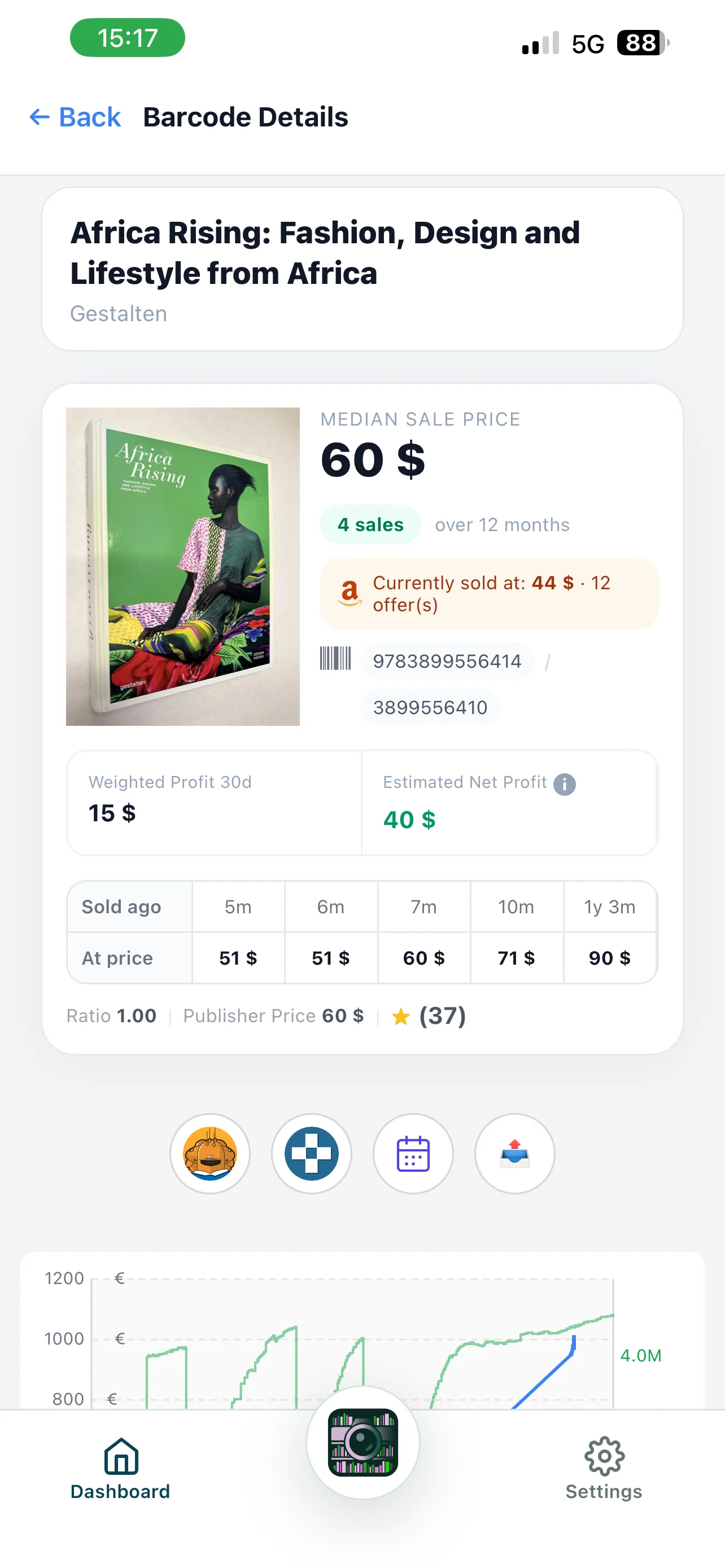
You take a photo of a shelf, a box, or a pile. The app sends the image to our vision model, which detects every spine, reads the title and author, then queries multiple market sources in parallel: Amazon, eBay, AbeBooks, and consolidated sales history. For each identified book, you get back:
- The median resale price over the last 12 months.
- The number of sales over that period (turnover — more important than price 80 % of the time).
- The current online price on major platforms.
- An estimated net profit after platform fees and shipping.
- The maximum recommended buy price to stay profitable.
All of it gets sorted automatically by our BiblioRank: a composite score combining net profit potential, sales velocity, and ID confidence. The app gives you a single ordered list — best books on top, weakest at the bottom. You know in two seconds what goes in your box.
What about the barcode scanner?
BiblioScan also ships with a classic ISBN barcode scanner. It's the right tool to verify a single book a friend wants to sell, or to double-check a tricky title after a shelf scan. But on a lot, the AI photo is unbeatable. Just want to check one book right now without installing anything? Use our free ISBN lookup tool — enter the ISBN and see instantly whether it's worth selling, no account needed.
The signals that decide for you
Most beginner resellers focus on the wrong number. They see "Amazon price: $45" and they buy. Six months later, the book is still in their inventory because nobody actually paid that price.
The three signals that actually matter:
| Signal | What it tells you | Useful threshold |
|---|---|---|
| Median sale price (12 mo) | The actual clearing price — not the optimistic ask from sellers who never close. | ≥ $12 to absorb fees and shipping |
| Number of sales (12 mo) | Turnover. An $80 book that sells once every two years won't pay your storage. | ≥ 3 sales/year for steady use |
| Net profit after fees | What actually lands in your pocket after platform fees and shipping costs. | ≥ $5 per book to make it worthwhile |
BiblioRank aggregates these three signals into a single ordered list, from the most profitable book down to the worst. The titles at the top are the ones that sell fast, well, and net of fees. Those are the ones you want.
A real-world case: a Friends of the Library sale, 80 books in 25 seconds
On January 9, 2026, I hit a Friends of the Library sale near my place. Flat rate: $1 per book. On the table, about 80 mixed titles — beat-up paperbacks, art books, technical references. No way to look at every one without blocking the line.
I took three photos of the entire table. Scan done in 25 seconds. Here's what BiblioScan returned, ranked from best to worst:
| Position in BiblioRank | Volume | Decision |
|---|---|---|
| Top of the ranking (net profit ≥ $8, regular sales) | 9 books | Buy now |
| Middle of the ranking (potential but slow turnover) | 4 books | Buy only if you have storage capacity |
| Bottom of the ranking or unidentified | 67 books | Leave on the table |
I bought the top-9 for $9. Listing them on eBay and Mercari took about 20 minutes. Over the next six weeks, the lot sold for $185 gross — about $156 net after fees and shipping. Average per book: $17 net, on a $1 acquisition cost.
Total time on site: under 2 minutes.
Without the AI scan, I'd have grabbed maybe two or three books on instinct, missed four or five that didn't look profitable to the eye, and burned 15 minutes on site. It's not magic — it's just the right information, at the right moment.
Where to resell your gems once you've identified them
Identifying value is half the work. Selling is the other half. My platforms by book profile:
- eBay — The default for most non-textbook resale in the US/UK. Wide audience, tolerant of variable conditions, easy listing.
- Amazon (Seller / FBA) — Best for textbooks, technical books, and niche professional titles. FBA is worth it once you're moving 150+ books.
- Mercari — Lower fees than eBay, friendlier for casual sellers. Good for general fiction and pop nonfiction at $5–30.
- AbeBooks — Where serious collectors look. The right home for rare, signed, first-edition, or out-of-print titles.
- Facebook Marketplace — Local pickup. Best for heavy art books, encyclopedias, sets, and anything where shipping kills the margin.
- Pango Books — Book-specific marketplace, fast listing by ISBN scan, growing US audience.
I cover this in more detail in my comparison of where to sell used books, with a real-world test comparing buyback offers and direct selling on a single title. Scanning is necessary — but you still need to pick the right exit channel.
Three use cases where AI scanning changes everything
Thrift stores and estate sales
The setup: 200 books on a folding table, a seller watching, two competitors hovering, one hour to clear the venue.
The play: Discreet photo of every shelf, glance at the BiblioRank, attack the highest-potential piles first. Buy the top of the ranking without hesitation.
Personal library cleanup
The setup: 400 books on your shelves and you want fewer. You don't know which are worth anything and which are headed to Goodwill.
The play: Photograph each shelf. BiblioScan does the sort in minutes. You keep what matters, sell the gems, donate the rest without second-guessing.
Estate liquidations and dealer buyouts
The setup: An estate with a full library to sell as a single lot, or a closing bookstore. Hundreds — sometimes thousands — of books to evaluate in one visit.
The play: Multiple photos per shelf, automatic estimated value across the whole inventory, and you make a lot offer knowing exactly what's inside.
My advice if you're starting in 2026
Don't overcomplicate it. The vast majority of value you'll create in your first year comes from two habits: scan before you buy, and sell on the right platform. Everything else — Excel tracking, margin dashboards, inventory management — comes naturally once you've got 200 books moving.
AI scanning isn't a magic wand. It gives you the right information, fast, at the right moment. What you do with it — which book to grab, what to ask, which platform to list on — is still your craft. But by removing uncertainty about real value, you turn reselling from a gut bet into an almost mechanical decision.
That's also why BiblioScan stays free for the first scans — once you try it on an actual yard sale, it just clicks.
TL;DR
One-at-a-time barcode scanning is dead for evaluating a lot. With a single shelf photo, BiblioScan identifies every book, calculates its median price, sales velocity, and net profit, then sorts everything from best to worst into the BiblioRank. In the field, that turns 13 minutes of evaluation into under 30 seconds — and stops you from selling books you didn't realize were valuable.