You open a seller account, scan your first stack of thrift-store books, and half the screen says "Request approval." Or worse: you've been selling for years, and one morning Amazon wants a supplier invoice for a paperback you paid 50 cents for at a library sale.
In the bookseller communities I follow, "everything is restricted on my account, what do I do?" gets asked, as one member put it, "at least 2x a week." And stories of accounts shut down over a counterfeit claim on a used book went from rare to routine in 2026. One seller summed up the mood: gating is a bigger problem than finding profitable books, and if you solve it, the rest is easy.
Two things up front:
- There is no magic ungating method. People selling "ungating courses" mostly sell courses.
- This isn't legal advice. If your account is deactivated with real inventory at stake, a lawyer or a specialized appeals consultant is worth the money.
The vocabulary in 30 seconds
| Term | What it means in practice |
|---|---|
| Gating / restriction | You need approval to sell a product, a brand (for books: a publisher) or a category. The "Request approval" button in Seller Central. |
| Prohibited | Never sellable, whatever you do (counterfeits, recalled products and so on). Restricted means "with permission," prohibited means "no." |
| Ungating | Getting that approval. Sometimes automatic, usually invoice-based. |
| Re-gating | An approval you had gets pulled, sometimes years later. |
| IP / authenticity complaint | A rights owner (publisher, brand, law firm) or a customer flags your offer as counterfeit or infringing. |
| Unsuitable inventory investigation | Amazon asks you to prove where a specific ASIN came from. |
| Section 3 | Account deactivation on policy grounds, often counterfeit-related. Requires a plan of action and documentation. |
One distinction you'll see in seller groups: a "gated" book shows a button to request approval, while a "restricted" one offers no button at all. The first you can apply for. The second, there's nothing to apply for.
Where the restriction sits: category, publisher or title
Amazon gates at several levels, which is why books are so confusing:
- A whole category (grocery, beauty and so on). Books aren't one of them: the category is open in principle.
- A brand, across categories. For a book, the brand is the publisher. That's where almost everything happens.
- A single product (ASIN): one title is blocked while the rest of the publisher goes through.
So an open category can be full of gated publishers and titles. "Books aren't a gated category" and "half my books are gated" can both be true on the same account.
Why a new account sees 80-95% of books as "restricted"
This is the question every beginner panics about, and the answer is reassuring: it's normal, and it doesn't last. A long-time seller put it bluntly: everyone is gated on 90-95% of items when they start out. One new seller in early 2025 found that 128 books out of a 200-book batch (64%) needed approval. By late 2025, new accounts were reporting 80-95%. In early 2026 someone posted "500 books and only 1 is ungated."
Why? Amazon doesn't think in terms of "used book." It thinks in terms of brands, and for a book the brand is the publisher. Once a publisher (or a studio, for DVDs) gets restrictions in place, they apply to everything with its name on it, new or used. And auto-ungating runs on three things a new account doesn't have yet: account age, sales volume and account health (an Order Defect Rate under 1%, low cancellations, few late shipments).
Veterans aren't immune. A 15-year seller said in late 2025 that one in three books he scanned asked for an invoice. Another went from 1-3% gated to about 20%. One seller estimates that 18 months ago roughly a quarter of publishers were gated and now it's almost all of them. That's one person's estimate, not Amazon data, but it matches what everyone describes.
The most sensitive publishers and brands
| When (as reported by sellers) | What changed |
|---|---|
| March 2025 | Re-gating of Universal, Marvel, Disney, Hasbro: 100-unit invoices, sometimes 300-1,000 |
| April 29, 2025 | Scholastic requires a supplier invoice of at least 100 units. One seller reported about 30 rejections despite real invoices |
| July 2025 | Pearson and Marvel re-gated |
| Late Sept 2025 | Ungating frozen roughly two weeks before Q4 |
| October 2025 | Oxford University Press: 100 invoiced units within 180 days |
| Nov 2025 → Jan 2026 | No more auto-ungating; invoices of 100 instead of 10; approvals revoked after the fact |
| June 2026 | Almost every publisher wants a wholesale invoice, even from veterans; the mobile app workaround gets closed |
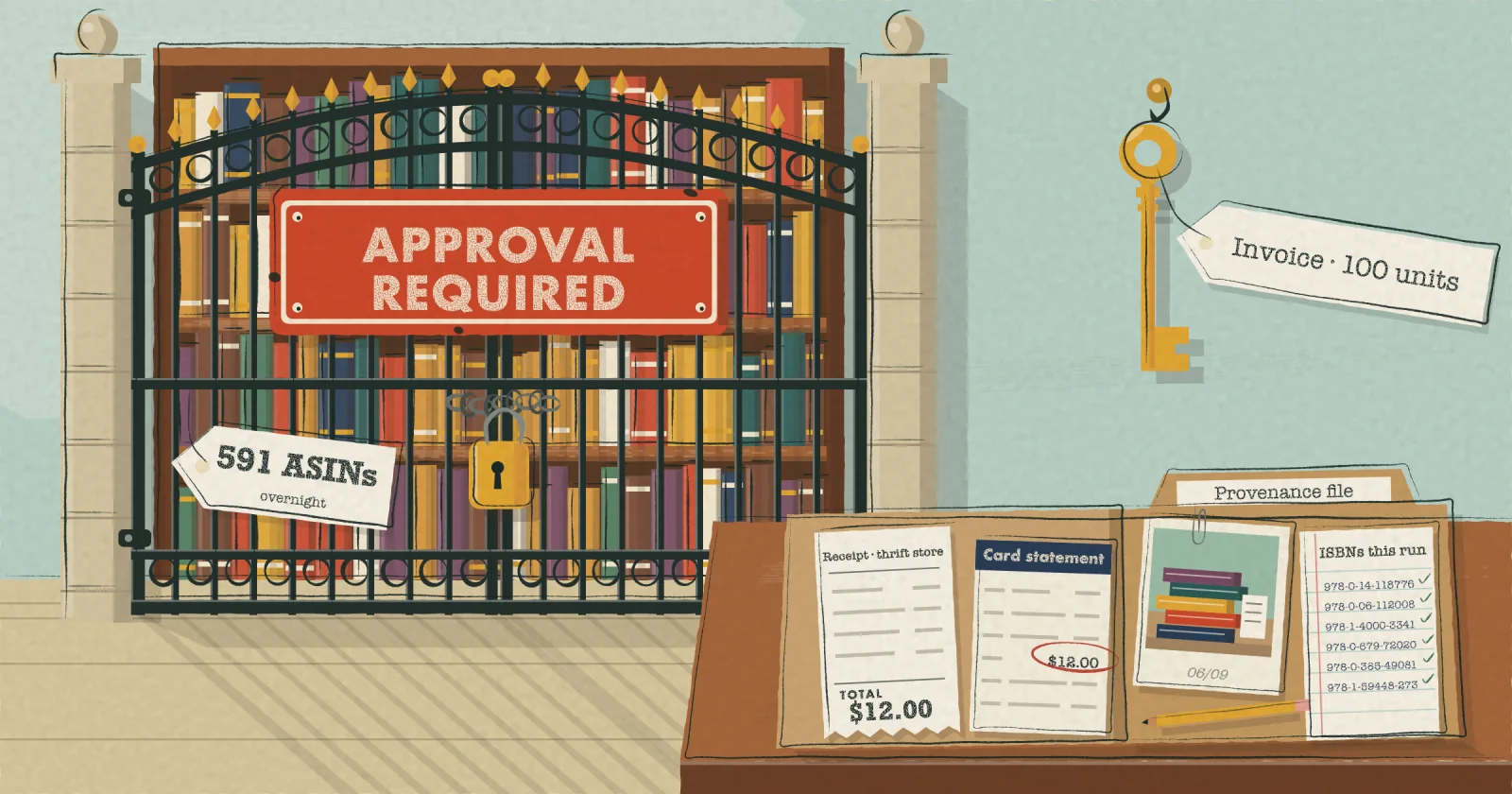
| August 2026 | Mass re-gating: one seller woke up to 591 ASINs gated overnight |
| Sept 18, 2026 | Textbooks re-gated |
On the counterfeit and complaint side, the names that keep coming up are the big textbook publishers (Pearson, Cengage, McGraw-Hill, Wiley, Elsevier, Macmillan/Bedford, LWW), the APA Publication Manual (described as the most counterfeited book out there), Oxford University Press, Scholastic, Thomas Nelson/HarperCollins, Zondervan, Crossway and NFPA. Several of these work with law firms that run test buys.
Re-gating: when an approval disappears
Re-gating hurts more than initial gating because it hits inventory you already bought, sometimes already sitting in an FBA warehouse. One seller said this summer that Amazon had gated him "in 1000's of brands" he'd been approved for and selling for seven years. A book can also become gated between the moment you build a shipment and the moment it's checked in.
What sellers do:
- Re-apply (sometimes it goes through, often not).
- Pull the inventory (removal fees run around $2 a book in recent reports) to sell elsewhere, or liquidate anything worth under about $20.
- Ship small and often to FBA instead of big boxes, to limit exposure.
- Steer clear of publishers known to re-gate, even if they're open on your account today.
What worked for ungating, and what doesn't anymore
Here's what US sellers actually used, no embellishment:
- Auto-ungating after a clean track record. The classic advice was: sell what's open, get to around 50 sales, wait 3-6 months, and one day the "approved based on your performance history" email shows up. Since November 2025, several sellers report seeing no auto-ungating at all.
- Applying from the Amazon Seller mobile app. For months it approved what desktop rejected ("about 75% of the time," one seller said). It was largely closed off in June 2026.
- A wholesale or distributor invoice (Ingram, Baker & Taylor, or a retailer that issues proper invoices) for 10 new copies. That used to unlock dozens of publishers at once. Today thresholds are often 100 units, and rejections are common even with genuine invoices.
- Setting the book aside and trying again later. Re-apply every two weeks or monthly. Some sellers don't submit anything for used books anymore: they sell what's open and wait for the rest to open up on its own, after a few weeks or a few months. It sometimes works, with no visible logic.
What an ungating invoice has to show
The specialist guides agree on the criteria (they change often, so double-check in Seller Central):
- it comes from an authorized distributor, with the supplier's name, address, phone number and website;
- it lists at least 10 units, and often 100 now for the touchy book publishers;
- it's dated within the last 90 to 180 days, depending on the case;
- it carries your business name and address exactly as they appear in Seller Central, character for character.
What gets rejected: retail store receipts (Walmart, Target and the like), online order confirmations, packing slips, pro forma invoices and quotes. In other words, a Goodwill receipt will never ungate a publisher. It can help with a provenance request, though, more on that below.
A rejection isn't a verdict
A good part of the review is automated. The "your document does not meet our requirements" message is often machine-generated, and support agents don't always know the exact reason a listing is blocked. Sellers describe ten, sometimes twenty rejections before the very same file went through. Open a ticket asking for the specific reason, and keep a record of every answer.
CDs and DVDs: one seller's workaround
One seller reports that Amazon accepts receipts from christianbook.com for music and video. The method: filter the store's CDs and DVDs from $0 to $5, in stock, order the cheapest ones (around $1 each), and if your account asks for 100 units, split the order, say 50 CDs and 50 DVDs, for roughly $100-120. Submit the actual receipt, not the order confirmation, under 180 days old, with your name or business entity and the address on your Amazon account. Expect several rejections before it sticks. That's one person's experience, it may stop working any day, and some brands aren't worth it at all: Universal, for instance, files IP complaints often.
What I don't recommend
Buying "ungating files" or courses, or doctoring documents in any way. Guides go for about $20-200 and full services for $200-500 or more per category, and all the risk stays with you: if an invoice is fabricated, Amazon suspends your account, not the provider's. Two red flags are enough to walk away: an invoice with no product to buy, or a request for access to your Seller Central.
Same goes for old "grandfathered" accounts, pre-2016 accounts that kept access to categories closed since, with listings asking up to $20,000 on forums. Buying a seller account breaks Amazon's terms and puts it at risk of being shut down.
And the good news: a restriction isn't permanent. A book that's gated today can sell elsewhere in the meantime (eBay, AbeBooks, a buyback site), and the more age and clean sales your account builds up, the more publishers open up. Mostly, it's a matter of time.
Invoices you can't produce for used books
This is the most absurd pain point. Amazon applies a new-goods logic to used goods: prove you bought this from a legitimate supplier. But a book from a thrift store, an estate sale or a library sale doesn't come with a supplier invoice. As one seller put it: you literally cannot get invoices for that because of how you source used items.
Reported cases:
- One seller said he "lost $63k and my entire business" over invoice requests on thrifted inventory.
- Another, deactivated over a library-sale book, was asked for the commercial supplier invoice showing where the library originally obtained the book.
- In 2025, a seller lost the Books category over a single complaint on $50k in sales, with $25k of inventory stuck.
- By summer 2026, sellers described a "crazy uptick" in requests; one estimated about 1 book in 30 triggered one.
Same issue with FBA reimbursements: if a used book gets lost in a warehouse, Amazon may ask for an invoice before paying. Many sellers have simply given up on those claims.
Worth knowing: when a group of sellers met with Amazon's enforcement side in spring 2025, Amazon reportedly acknowledged its rules were broad-based, said it hadn't fully considered the used-book sourcing model, and claimed to be "open to alternative authenticity verification." Nothing concrete has come of it that sellers can point to.
What sometimes gets accepted (no guarantee)
The experiences converge on one thing: a receipt plus the matching bank or card statement gets through more often than people expect. Several sellers got a Goodwill or thrift receipt accepted alongside a card statement showing the same amount on the same date, sometimes with the store's tax ID. For estate sales and private purchases, some used a receipt signed by the seller plus the matching payment. Escalation through an "egregious" ticket also comes up.
It's not consistent. Amazon accepts or rejects without explanation. But it's the only route with repeated success stories.
IP or authenticity complaint: accept or dispute?
There's no consensus, and I won't invent one. Here's what sellers describe:
- Small account, one-off book, low stakes: many acknowledge and delete the listing. A violation with no follow-up generally drops off after about 180 days, but each complaint costs Account Health Rating points (around 10, by seller reports). Caveat: some sellers saw an acknowledgment trigger an "at risk of deactivation" warning.
- Counterfeit claims or deactivation: never ignore. One seller who always disputes uses an IP attorney and went six weeks without sales.
- Delete, don't just close the listing, including drafts and out-of-stock offers, which stay exposed to complaints.
- Stick to facts in your responses: where, when, how much, documents attached. Don't tell a story you can't back up.
The free BooksRun counterfeit checker (for textbooks) is widely used, but even its fans call it a "very rough guess." Accounts have been closed despite an "OK" result.
What the sellers who last do differently
Across hundreds of posts, the sellers who come through these waves intact share the same habits:
- They sell what's open, even at thin margins, instead of fighting for what's closed.
- They don't depend on Amazon alone. The move to eBay has been massive since late 2025 (one seller says a good book usually fetches at least half its Amazon price there), and PangoBooks gets mentioned because it never gates, at a 20% fee. A gated book isn't an unsellable book, it's a book to sell somewhere else. More on that in the best sites to sell used books.
- They avoid high-risk categories (big-publisher textbooks, licensed media) unless they have invoices.
- They keep a provenance file for every sourcing run, before they ever need it.
A provenance file, in practice
| Item | How to build it | Why |
|---|---|---|
| Receipt | Ask every time, even at yard sales (a handwritten, dated, signed receipt) | It's the document Amazon sometimes accepts |
| Traceable payment | Pay by card when you can; otherwise log the cash withdrawal | The statement line matching the receipt is what makes the case |
| Photo of the haul | Books laid out with the receipt, before you leave | Physically ties the books to the transaction |
| ISBN list for the session | What you bought that day, at that place | Lets you match an ASIN to the right receipt months later |
| Place and date | Store name and location (Goodwill on X street, the county library sale) | Supports a factual answer |
| Archive | One folder per month or per source, scanned to PDF | Requests can arrive a year after the sale |
Practical checklist
Before you buy
- Check the restriction on your own account (Seller Central, the Amazon Seller app, or BiblioScan linked to your account). Generic restriction flags that don't go through your account are often wrong.
- Skip big-publisher textbooks and licensed titles if you don't have invoices.
- A gated book that's worth it elsewhere is still a good buy: sell it on another platform while your account opens up.
- Look at value on other platforms: if it's gated on Amazon, is it still worth buying for eBay, AbeBooks or a buyback?
- Get a receipt and pay traceably.
Before you list
- Recheck the restriction on shipment day (re-gating happens between purchase and shipment).
- Send FBA in small batches.
- List a used book as "Like New," never "New," even if it looks untouched. Without an invoice, "New" invites complaints.
- File the receipt, photo and ISBN list in that month's folder.
- Delete old drafts and out-of-stock listings you're not using.
If Amazon asks for an invoice
- Don't panic and don't answer within the minute. Read exactly what's asked and the deadline.
- Gather: receipt, matching bank statement, haul photo, ISBN list.
- Answer factually: where, when, how much, documents attached. No undocumented story.
- No proof and low stakes: delete the SKU and sell the book elsewhere.
- High stakes (account, large inventory): open a ticket, escalate, and get a lawyer or appeals consultant.
What BiblioScan does, and doesn't do, here
Let me be straight: BiblioScan doesn't ungate anything. It won't get you approved, it doesn't produce invoices, and it's no substitute for a lawyer when your account is on the line. What it does is keep you from buying blind.
- Your restrictions, on your account, before you pay. Link your Amazon Seller Central account in settings and pick your marketplace. On the shelf photo you just took, every book worth looking at gets a badge: "Approved," "Approval required" (with the link to request it) or "Not eligible." That's Amazon's answer for your account at scan time, not a generic list. It's a snapshot, though: recheck on shipment day.
- Plan B, with numbers. When a book is gated, you still see its real resale value (median sold price) and how often it sells, a recommended max buy price, and live offers from 20+ buyback sites (BooksRun, TopDollar4Books, World of Books and more). You decide whether to buy it at all, and for how much.
- A record of your buying. Sourcing locations keep track of where you buy and what each place earns you, buy lists keep what you picked up on a given run, and inventory tracks what you have listed. It's not an invoice and Amazon doesn't have to accept it, but it lets you quickly trace which book came from which run so you can pull the right receipt and statement.

The FBA calculator shows what's left after fees, and the free ISBN lookup needs no account. If you're still building your sourcing routine, where to find used books to resell pairs well with this guide, the best book buyback sites covers where gated duds can go, and the used book Buy Box after the Prime bump covers the other big 2025-2026 change.
Bottom Line
A new seller account gated on most books is normal, and it has gotten worse since late 2025: no more auto-ungating, 100-unit invoices, mass re-gating, and invoice requests that used goods can't satisfy. There's no trick that fixes it. What protects you is boring: sell what's open, don't rely on Amazon alone, avoid high-risk titles, and keep a receipt, the matching statement, a photo and an ISBN list for every sourcing run. And to see what's gated on your own account before you pay, scan your next shelf with 5 free credits, no card required.
FAQ
Why are all my books restricted on my new Amazon seller account?
Because Amazon restricts by brand, and for books the brand is the publisher. Restrictions requested for new copies apply to used ones too. A new account is gated on most publishers, often 80-95% of books in 2025-2026 according to sellers.
How do I get ungated in books on Amazon?
There's no guaranteed method. What has worked: a clean sales history on a healthy account, an authorized distributor invoice (often 100 units now), applying from the mobile app (largely closed in June 2026), and patience. Don't pay for courses promising otherwise.
Can I use a store receipt to get ungated?
No. For ungating, Amazon rejects retail receipts, order confirmations, packing slips and pro forma invoices. It wants a recent invoice from an authorized distributor, with your exact business name and address. A receipt plus the matching card statement can help with a provenance request, though.
Why did Amazon re-gate books I was already approved for?
Publishers keep adding restrictions and Amazon revokes approvals without notice. Sellers reported 591 ASINs gated overnight in August 2026. Ship small, recheck before sending, and have a plan B channel.
Amazon wants an invoice for a book I bought at a thrift store. What do I do?
Provide what you have: receipt, matching bank or card statement, photo of the haul. That combination has been accepted for several sellers, with no guarantee. No proof and low stakes: delete the listing and sell the book elsewhere.
Should I accept or dispute an IP complaint on a used book?
It depends on the stakes. For a single book on a small account, many delete the listing. For counterfeit claims or deactivation, never ignore it and get professional help. This isn't legal advice.
Can I sell a used book as "New" on Amazon?
Don't. Without a supplier invoice, "New" exposes you to complaints. List it as "Like New" even if it looks unread.