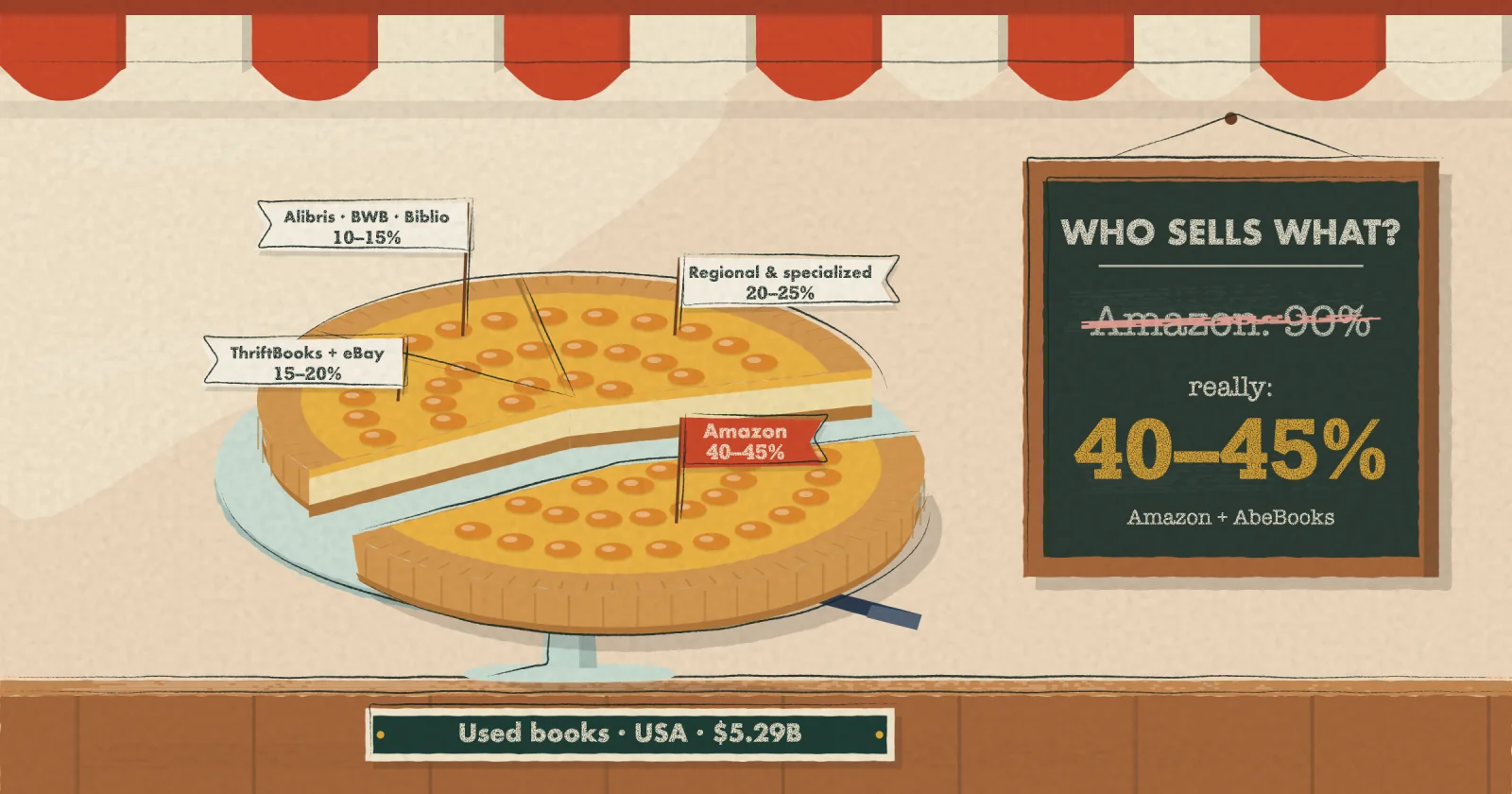
I'm writing this article because there's one stat that keeps circulating in every article, podcast and LinkedIn post about the used book business: "Amazon controls 90% of the used book market." It's everywhere. It's in antitrust debates. It's in publishing industry panels. It's in every "why you can't compete with Amazon" piece.
It's wrong.
Or rather — it's a genuine statistic, but it's about a different market. Amazon does control ~90% of something in books. Just not used books. I spent a few days digging into antitrust filings, Carnegie Mellon academic research, the financials of ThriftBooks, AbeBooks, eBay and Better World Books. What comes out is a picture that's far more interesting — and far more actionable if you resell books — than the lazy "Amazon owns everything" narrative.
The Three Amazon Numbers Everyone Mixes Up
Before going any further, we need to separate three completely different markets. Amazon's market share in books in the US looks like this:
| Market | Amazon's Share | Source |
|---|---|---|
| E-books (Kindle ecosystem) | ~90% | Hagens Berman antitrust filing |
| New print books sold online | ~90% | House antitrust subcommittee report |
| All print books (all channels) | ~50%+ | Same report |
| Used books (global) | 40-45% | Persistence Market Research |
That "90%" everyone throws around comes from the e-book and new books online categories. Those are real monopolies that the Federal Trade Commission and the House antitrust subcommittee are actively scrutinizing. But the used book market — which is what this article is about — is a very different beast.
Amazon is still the dominant player. Just nowhere near 90%.
The Size of the US Used Book Market
The numbers are big. Here's what the data shows for the US specifically:
| Indicator | Value |
|---|---|
| US used book market (2023) | $5.29 billion |
| US projected 2032 | $8.64 billion |
| US CAGR | 5.6% |
| Global used book market (2024) | $14.65 billion |
| Global projected (2033) | $45.1 billion |
| Online share of used book sales (global) | 41% |
Sources: Credence Research, Fact.MR, Persistence Market Research.
That $5.29B US market is big, but it sits under the much bigger $32.5B US book publishing industry overall. Used books still represent roughly 16% of the total US book business by value, much lower than France's proportional share (and I'll explain why in a minute).
Who Actually Sells Used Books in the US
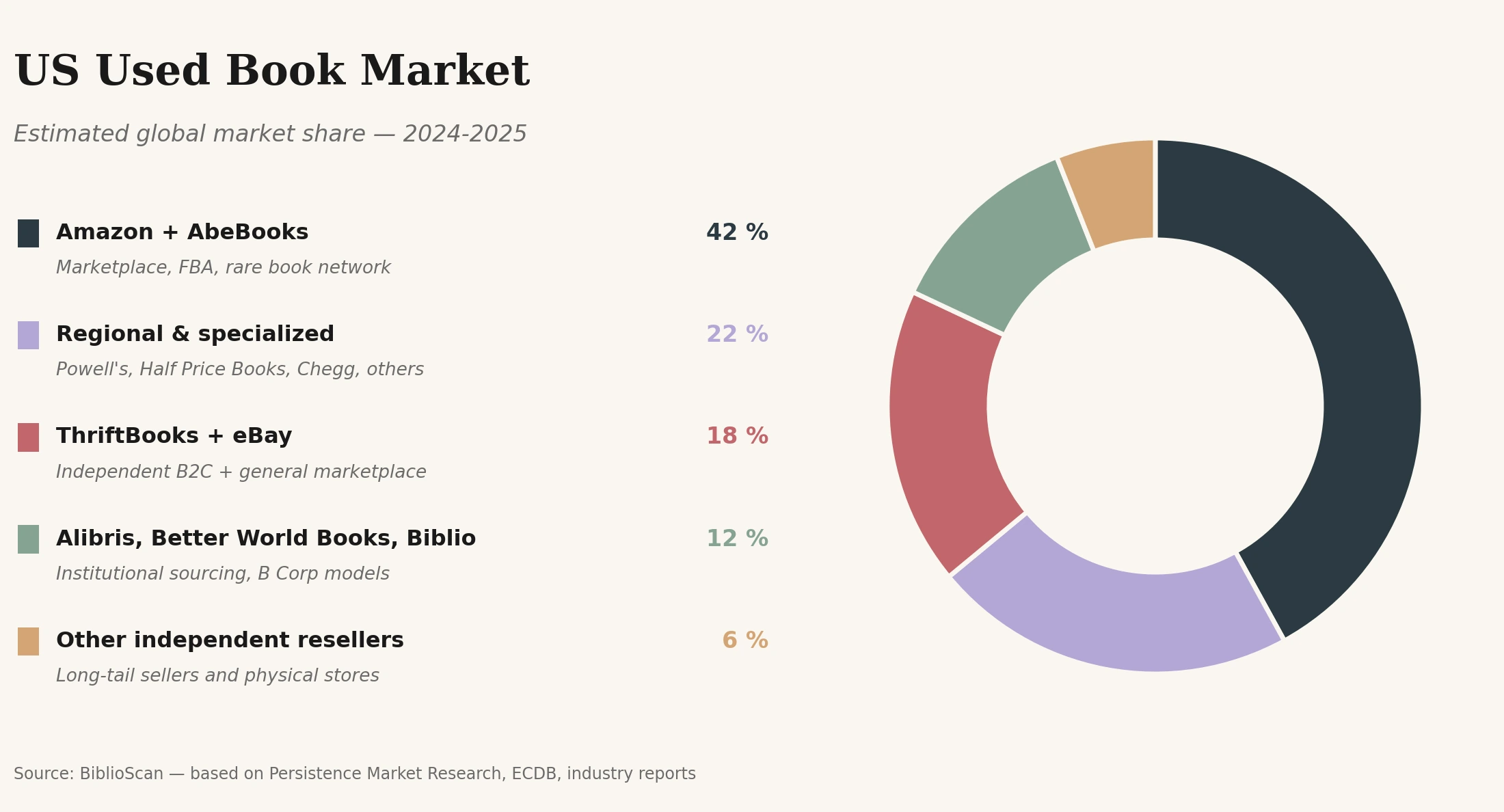
Based on global market share estimates, the breakdown looks like this:
| Player | Combined Market Share | Business Model |
|---|---|---|
| Amazon (incl. AbeBooks) | 40-45% | Marketplace + FBA logistics + rare/specialist acquisition |
| ThriftBooks + eBay | 15-20% | ThriftBooks: centralized B2C; eBay: fragmented C2C |
| Alibris, Better World Books, Biblio | 10-15% | Ethical positioning, institutional sourcing, rare books |
| Regional & specialized | 20-25% | Powell's, Half Price Books, Chegg (textbooks), independent bookstores |
Source: Persistence Market Research. Let me walk through each of these because the dynamics are very different.
Amazon: The Infrastructure Giant
Amazon isn't a used book seller in the traditional sense. It's an infrastructure. The used books sold "on Amazon" are overwhelmingly sold by third-party merchants — over 2 million active sellers on Amazon Marketplace, many of whom specialize in books.
The model works like this:
- A third-party seller (could be a single person, could be a giant like Discover Books) sources used books from thrift stores, estate sales, library liquidations, or wholesale.
- They scan each book with a scout app — BiblioScan being one of the few that works in the US, UK, France, Germany and Spain at once — to pull real-time market data: sales rank, FBA competition, median resale price and profit estimate. BookScouter is also useful as a parallel buyback-offer aggregator.
- Most pros target a 4x multiplier at purchase to absorb FBA fees and storage costs.
- They ship the inventory to an Amazon fulfillment center ("Fulfilled by Amazon" / FBA).
- Amazon handles storage, shipping, returns, customer service. Takes a 15% commission + FBA fees.
Amazon also owns AbeBooks, acquired in 2008. AbeBooks is the leading online platform for rare, out-of-print, and antiquarian books, connecting thousands of independent booksellers worldwide. This acquisition is why Amazon's grip on rare/collectible books is so strong: they own both the mass market platform and the specialist one.
The dark side: commingling
Amazon treats identical books (same UPC/ISBN) from different sellers as interchangeable for logistics optimization. This means a book you sent from California could be shipped to a customer in New York using another seller's inventory from a Pennsylvania warehouse. This creates a major quality-control vulnerability: if one seller mixes in counterfeit or poor-condition copies, every legitimate seller's reputation gets dragged down. This is especially documented in expensive textbook categories and mainstream bestsellers.
ThriftBooks: The Independent Giant That Actually Works
This is probably the most interesting story in the US used book industry. ThriftBooks started in 2003 as just another third-party Amazon seller. In 2007, they pivoted hard and launched their own site. Fast-forward to today:
- 2024 revenue: $276 million on thriftbooks.com alone (ECDB)
- 13 to 19 million SKUs depending on source
- 250 million books sold since inception
- Double-digit revenue growth sustained for over 10 years
- Holiday sales up 20% YoY in 2023, with no discounting during Cyber Week
Sources: ECDB, Digital Commerce 360, Modern Retail.
Their strategy is a masterclass in escaping the Buy Box trap. On Amazon, the Buy Box algorithm forces sellers into a race to the bottom on price. ThriftBooks decided to skip that game entirely:
- Own the customer. Build direct-to-consumer instead of renting Amazon's audience.
- ReadingRewards loyalty program. Launched 2015, restructured 2018. Literati tier grew 30% YoY in 2023, Bookworm tier grew 20%. Millions of members earning points toward free books.
- Generative AI for recommendations. Especially useful for out-of-print titles where human curation is too expensive.
- Proprietary dynamic pricing software that adjusts prices across thriftbooks.com, Amazon, eBay and Walmart in real time based on inventory velocity.
- Social media presence (TikTok, Instagram) to reach younger buyers who don't think of Amazon as a bookstore.
ThriftBooks is essentially the proof that you can build a successful, independent used book business at scale in the US. But the entry cost — proprietary logistics, millions in tech investment, 20 years of compounding — is way out of reach for individual sellers.
eBay: The Declining Pioneer
eBay remains a massive platform globally. 2023 numbers:
- $73.2 billion GMV (Statista)
- 132 million active buyers
- 18 million sellers
But on used books specifically, eBay has been losing ground for years. The reasons are structural:
- Conversion rate: ~1-3% on eBay vs 10-15% on Amazon. Amazon Prime (200M+ members globally) pre-sells buyers on 2-day shipping that eBay can't match.
- Search UX: Amazon unifies all offers for a given ISBN on a single product page, algorithmically sorted. eBay spreads the same book across hundreds of separate listings — decision fatigue for the buyer.
- No equivalent to FBA at scale.
Where eBay still wins: rare, signed, vintage, and condition-specific books. When a buyer is looking for a specific edition from 1967 and the photos matter more than the barcode, eBay's listing model works. But for bulk volume on modern titles, most pro sellers I know have migrated to Amazon FBA with a secondary ThriftBooks listing.
Better World Books: The Ethical B Corp
Better World Books is the most interesting ethically-positioned player. Founded in 2002, B Corp certified:
- 475+ million books resold, reused, or recycled (diverted from landfills)
- 38+ million books donated
- $35+ million raised for global literacy
Their economic edge is free sourcing. Libraries, universities and nonprofits prefer working with a B Corp when liquidating stock. That translates into a continuous flow of merchandise at near-zero marginal cost. Combined with institutional purchasing contracts, it's a sustainable niche — not the scale of ThriftBooks, but consistent profitability.
The Textbook Segment: A Whole Different Market
Here's a big difference between the US and most other countries: college textbooks. This is the single most profitable niche in the US used book market, and it has no real equivalent in France or most of Europe.
The numbers:
- Individual new textbooks: $100-300 per copy
- Average spend per full-time 4-year student (2024-25): $1,290/year on books and supplies (Research.com)
- US higher education course materials market (2024): $4.35 billion
- 40% of students buy textbooks from Amazon (NACS)
- 82% of students still buy at campus stores (at least one book)
- 45% of textbooks are purchased used according to McKinsey's ongoing survey
Key players in the textbook segment:
- Chegg: Textbook rentals + study help. $616M revenue in 2024 (Business of Apps), 6.6 million subscribers. BUT: declining fast. Revenue down 13.9% YoY, net loss of $837M in 2024, hit hard by ChatGPT eating their study-help revenue.
- Amazon: 40% of student textbook purchases.
- Campus bookstores (mostly run by Barnes & Noble College or Follett): dominant physical channel.
- ThriftBooks, AbeBooks: strong for older editions.
- BiblioScan: AI shelf scanner that returns the real median resale price and profit per textbook in seconds — works on Amazon US data, no ISBN typing. For a single book, the free ISBN lookup returns the title, edition and a resale verdict without an account.
- BookScouter, BookFinder: price comparison aggregators.
For anyone reselling in the US, textbooks remain the highest-margin category if you can source them cheaply. End-of-semester campus liquidations, library sales, and estate sales are the classic goldmine. A textbook bought for $2 at a thrift store can easily sell for $80-150 on Amazon. The math is different from anywhere else in the world.
What Actually Happens Economically: The Carnegie Mellon Finding
This is the piece of the puzzle that nobody in the "Amazon is killing publishing" camp ever cites, because it undermines the whole narrative.
In 2006, researchers at Carnegie Mellon ran the first rigorous economic analysis of used book sales on Amazon (full study here). They used actual transaction data.
What they found flies in the face of publisher narratives:
| Metric | Result |
|---|---|
| Cross-price elasticity (new vs used demand) | 0.088 (essentially zero) |
| % of used sales that actually cannibalize new | 16% |
| % of used sales that are net-new (wouldn't happen at new price) | 84% |
| Average used discount vs new | -50.6% |
| Discount vs traditional physical used bookstores | -38% to -75% |
| Annual consumer surplus created | +$67.21 million |
| Publisher loss | -$45.05 million (only 0.3% of total profits) |
| Amazon profits captured | +$65.76 million |
| Net total welfare | +$87.92 million |
Translation
Used book sales on Amazon don't kill new book sales. They create a mostly-additional market of price-sensitive buyers who wouldn't have bought at new prices anyway. The Authors Guild and the Association of American Publishers have been lobbying against used book sales for 20 years based on an intuition the data simply doesn't support.
The publishers who suffer most aren't the big ones — they're the long-tail authors and small presses whose books could have sold one more new copy. But in aggregate, the "cannibalization" fear is wildly overstated.
The Antitrust Picture: Where Amazon Actually Gets Sued
The US has no price-fixing law like the French loi Lang to protect bookstores. Regulation happens through antitrust — and here, Amazon is in real trouble. But again, the concern is not about used books.
The central accusation in the ongoing class-action suits (Bookends & Beginnings v. Amazon, Hagens Berman v. Amazon, and related cases) is Amazon's use of Most-Favored-Nation (MFN) clauses — "price parity" contracts with the Big Five publishers (Penguin Random House, Hachette, HarperCollins, Macmillan, Simon & Schuster).
MFN clauses guarantee that whatever deal a publisher cuts with any retailer, Amazon gets at least as good a deal. Meaning if Penguin Random House offers Barnes & Noble a 5% promotional discount, Amazon automatically gets the same — or better.
The effect:
- Competition is mathematically neutered. No retailer can ever out-price Amazon, because Amazon always matches or beats them.
- New book retail prices stay artificially high across the market, because retailers can't afford to discount if Amazon will match and still win on logistics.
- Used book sellers benefit indirectly. Because new prices stay high, the 50% used discount remains attractive. Amazon captures margin on both ends via marketplace commissions.
The European Commission investigated the same MFN clauses in 2015 and reached a settlement in 2017, but most legal experts consider it toothless. The EU is now pushing for Kindle interoperability — forcing Amazon to let users read e-books from competitors on Kindle devices. That would actually crack the ecosystem lock-in.
Practical Takeaways If You Resell Used Books in the US
After all this research, here's what I'd tell anyone looking at the US used book market in 2026:
- Amazon FBA is still the default at scale. If you're processing 500+ books/month, FBA is hard to beat. The logistics are unmatched, and Prime shipping sells books for you.
- Start smaller with Amazon FBM or eBay if you're under 50 books/month. FBA fees will eat you alive on low volume, and you don't need Prime for niche books anyway.
- Textbooks are still the goldmine. Target campus end-of-semester liquidations, fraternity/sorority house cleanouts, and estate sales with students' deceased family members. A single rare engineering or medical textbook can net $100-200 profit.
- Don't ignore ThriftBooks and AbeBooks as listing destinations. Listing the same inventory across ThriftBooks, Amazon, and AbeBooks (with dynamic pricing software) is the standard pro playbook.
- Keep an eye on counterfeits. Amazon's commingling system is getting worse for authentic sellers. Pay for the no-commingle / brand-protected inventory settings if you're selling textbooks or premium editions.
- Scout apps are non-negotiable. No pro sources blind anymore. BiblioScan is the fastest way to do it: scan a whole shelf at once instead of one barcode at a time, get the real median resale price, sales velocity, FBA competition and net profit estimate per book, and it covers the US, UK, France, Germany and Spain in a single app — so the same scout workflow works whether you're sourcing at a Goodwill outlet, a French vide-grenier, a German Flohmarkt or a Spanish rastro. BookScouter and BookFinder are useful complements when you want to cross-check buyback offers.
- Track Keepa data. For any book you're about to buy, check its historical sales rank and price on Keepa. A book ranked 1M+ that sells 2-3 times a year at $50 is still a good flip if your capital is slow. A book ranked 50K but flooded with FBA competition at razor-thin margin is a trap.
What's Coming in 2026
A few things are worth watching:
- Amazon antitrust cases (FTC + private suits) are moving through courts. If they result in forced structural changes to the Marketplace or FBA, the entire reseller economics could shift.
- Chegg's decline is freeing up market share in textbook rentals. ThriftBooks, Amazon, and new AI-native entrants are grabbing it.
- Generative AI is reshaping book discovery. ThriftBooks is betting hard on this. Expect recommendation-driven purchases to grow.
- Sustainability messaging is moving from nice-to-have to decisive. Gen Z buyers explicitly prefer used for environmental reasons — a shift that's different from Europe where cost is still the primary driver.
The used book market isn't dying. It's growing — just not in the dramatic "Amazon ate everything" way that gets the headlines. If you're reselling books in the US in 2026, you have more tools, more data, and more channels than ever before. The sellers who will thrive are the ones who understand the actual market structure, not the myth of total Amazon dominance.
TL;DR
The US used book market is worth $5.29B and growing 5.6% per year. Amazon + AbeBooks hold 40-45% globally, not 90% — that myth comes from e-books and online new books, two different markets. ThriftBooks ($276M revenue) is the proof an independent scale player can survive. Textbooks remain the highest-margin niche. Before buying any book for resale, scan it, check Keepa, and list across Amazon FBA + ThriftBooks + AbeBooks.
Main Sources
- Carnegie Mellon — Internet Exchanges for Used Books: Welfare Impact
- American Booksellers Association — Amazon Antitrust White Paper
- Hagens Berman — Amazon Class Action on E-book Price Fixing
- Persistence Market Research — Second Hand Books Market
- Credence Research — US Second Hand Books Market
- ECDB — ThriftBooks Revenue Analytics
- Modern Retail — How ThriftBooks Fends Off Competition
- Digital Commerce 360 — ThriftBooks AI Strategy
- Business of Apps — Chegg Statistics 2026
- Research.com — College Textbook Digital Transformation
- Statista — Amazon vs eBay Comparison
- Better World Books — FAQ
This article will be updated as the Amazon antitrust cases progress and as 2025 fiscal-year data becomes available for private companies like ThriftBooks.